
The Digital Scarcity Engine
21 million.
That’s the number. Not a target, not an estimate. It's the total number of Bitcoin that will ever exist. There will never be 21 million and one. This isn't a corporate promise or a government policy that can change with the political winds... it's mathematics. It is written into the core of the code that powers the entire network, and it can't be changed.
Now, contrast that with the money in your wallet. The U.S. Federal Reserve can, and does, create more dollars out of thin air. In the last few years alone, trillions of new dollars have flooded the system. Each new dollar printed makes the ones you already hold just a little less rare, a little less valuable. This is the opposite of scarcity. Bitcoin's design is a direct response to that reality. Its supply is fixed, predictable, and transparent to anyone who wants to look.
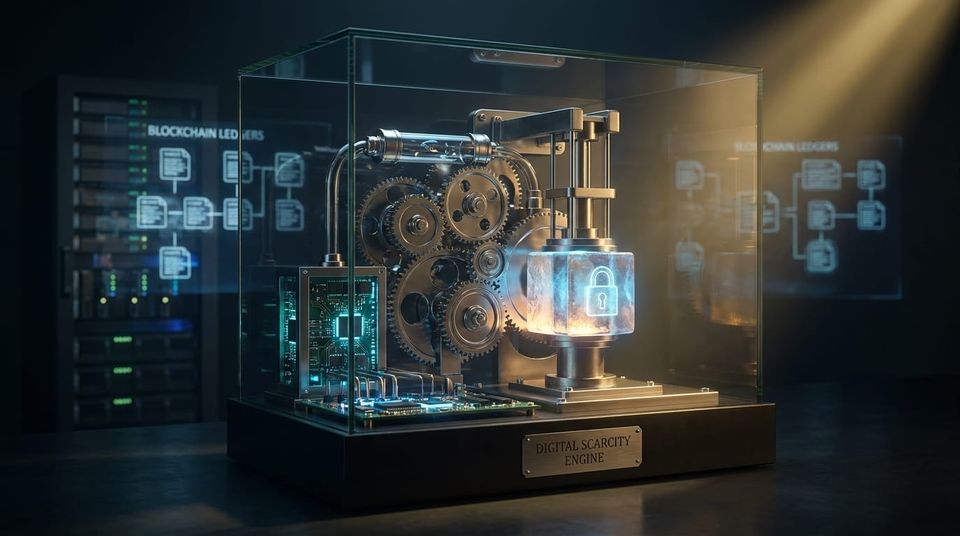
This is the digital scarcity engine at work. It's a system that allows for something to be rare and unique in a world where 'copy and paste' is the default. This engine isn't run by a CEO in a boardroom; it's run by a global, decentralized network of computers all agreeing on the same set of rules. This creates a new kind of property-one that is purely digital but has the characteristics of a physical commodity, like gold. You can't just print more gold, and you can't just mint more Bitcoin.
- Bitcoin's total supply is permanently capped at 21 million coins, a rule enforced by its code.
- This fixed supply stands in stark contrast to traditional fiat currencies, which can be printed by central banks, potentially leading to inflation.
- Digital scarcity is made possible by decentralized blockchain technology, which verifies ownership and prevents duplication without a central authority.
- This concept is the foundation for the value of digital assets like cryptocurrencies and unique Non-Fungible Tokens (NFTs).
Frequently Asked Questions
What exactly is 'digital scarcity'?
Digital scarcity is the concept that a digital item can be verifiably unique and limited in quantity. For decades, anything digital-a song, a photo, a document-could be copied perfectly and infinitely, making true rarity impossible. Blockchain technology solved this problem by creating a public, unchangeable ledger.
This ledger can track the ownership and history of a specific digital file, proving its authenticity and confirming its limited supply. It allows a digital asset to behave like a physical collector's item, where its rarity is a key component of its identity and value.
Is Bitcoin the only example of digital scarcity?
No, while Bitcoin is the pioneering and most famous example, the engine it created is now used for many other assets. Non-Fungible Tokens (NFTs) are a perfect illustration. An artist can create a piece of digital art and mint it as a '1 of 1' NFT on a blockchain. This creates a provably unique original version that cannot be duplicated, even if people copy the image file.
This same principle applies to limited-edition digital concert tickets, unique in-game items that players truly own, and even digital real estate in virtual worlds. The underlying technology allows for provable rarity to be programmed into almost any kind of digital good.
How is this different from a limited-edition item in a video game?
The crucial difference is decentralization and true ownership. When a game company creates a 'rare' sword, they still control the server and the database. They could theoretically create more, alter its properties, or shut the game down entirely, making your item vanish. Your ownership is conditional and exists only within their private system.
An asset on a public blockchain, however, is not controlled by any single company. You hold the cryptographic keys to that asset in your own digital wallet. Its scarcity and existence are verified by the entire global network, independent of its original creator. You don't just have permission to use it; you truly own it.
Why does scarcity create value in the digital world?
It creates value for the same reason it does in the physical world: supply and demand. Humans tend to value things that are desirable, useful, and not easily obtained. Gold is valuable not just because it's shiny, but because it's difficult to mine and its global supply is finite. The digital scarcity engine introduces this exact property into the digital realm for the first time.
By making a digital asset provably rare, it moves from being a simple file that can be endlessly copied to a unique object that can be owned. This allows a market to form around it, where its price is determined by how many people want it versus how many are available. It's the difference between owning a poster of the Mona Lisa and owning the actual painting.