
Pricing the Digital Self: The Strange New Economics of Valuing Your Online Identity and Avatars

The Price Tag on Your Digital Ghost
Your personal data has a median market value of $5,000 per year. That’s the number. The price tag on the digital ghost that follows you across the internet. It’s not an estimate of what it could be worth someday… it’s what advertisers, data brokers, and tech platforms believe it’s worth right now, according to a 2023 Technology Policy Institute report. This isn’t about your bank account or your social security number. This is the value of your clicks, your searches, your location history, and your late-night shopping habits, all bundled up and sold to the highest bidder.
Think about the “free” services you use every day. They aren’t free. They’re data-for-service transactions. For a company like Meta, advertising accounts for over 97% of its total revenue. That revenue doesn't come from a subscription fee you pay; it comes from advertisers paying to access the profile Meta has built on you. They’re paying for a piece of that $5,000 valuation, and they’re doing it billions of times over.
From Passive Data to Active Avatars

But the economics of your digital self extends far beyond the data you passively create. It’s also about the identity you actively build. We’re talking about the world of virtual goods, where people spent a staggering $54 billion in 2020. That’s more than the entire film industry’s box office revenue that year. A single digital skin in a game like Fortnite can cost $20, and millions are sold. You’re not just buying pixels; you’re buying status, identity, and expression in a digital space where you spend hours of your life.
This drive for digital ownership reached a fever pitch with NFTs. At its peak in 2021, the market for these unique digital assets soared past a $40 billion valuation. People were buying digital art, virtual real estate, and collectible avatars for tens of thousands, sometimes millions, of dollars. While the market has since corrected by more than 90% from its high, it proved a critical point: people are willing to pay real, substantial money for provably scarce digital items. The concept of a digital asset with a clear owner is no longer a fantasy.
The Granular Breakdown of You
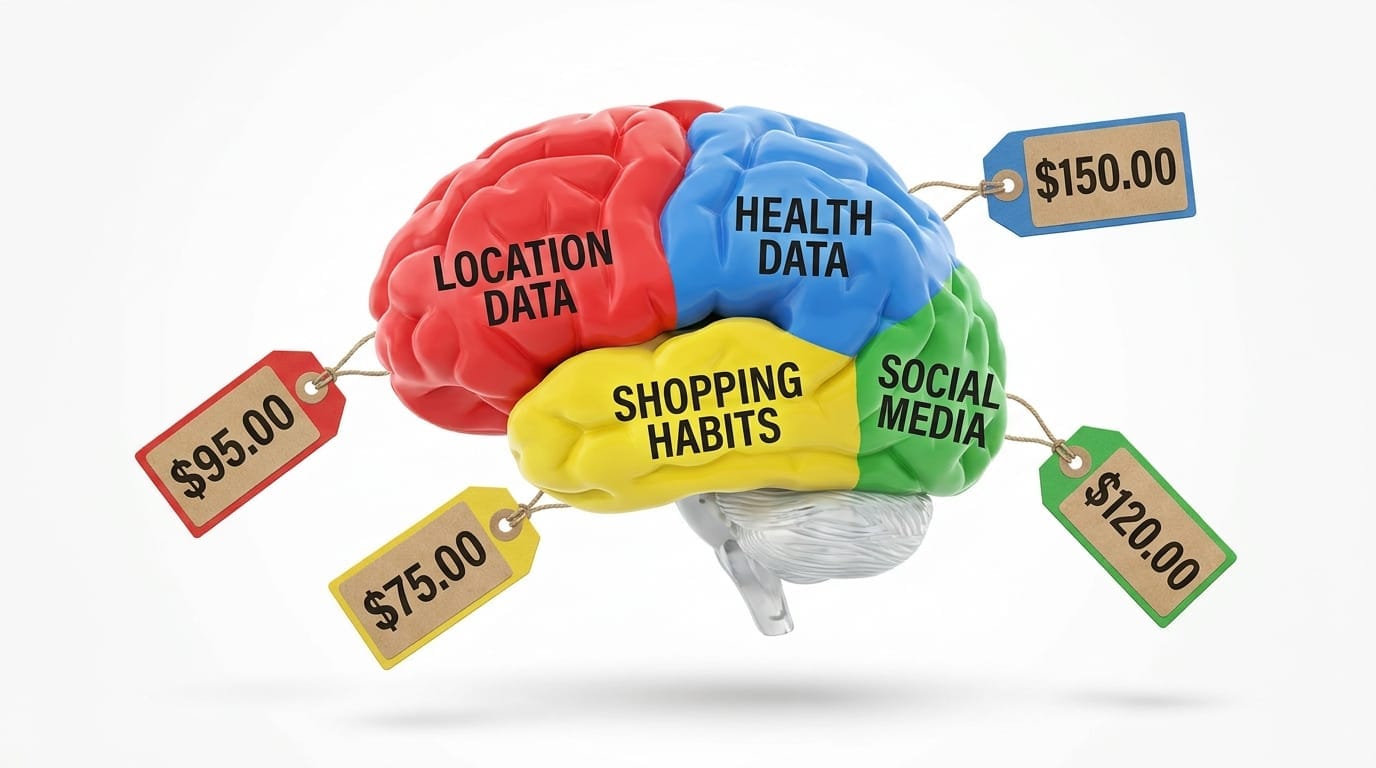
So where does that five-thousand-dollar valuation come from? It’s not one single item. It’s an aggregation of thousands of tiny data points, each with its own price tag. The market for you is a complex, high-frequency trading floor.
- Your raw location data, tracked by apps on your phone, can be worth up to $14 per user per month to marketing firms and hedge funds trying to predict retail foot traffic.
- Anonymized health data, from your fitness tracker to your prescription history, has a massive range, selling for as little as $0.50 or as much as $500 per individual record depending on its detail.
- Your shopping habits are a goldmine. The average Amazon Prime member was estimated to generate $1,400 in revenue for the company in 2022, a value derived directly from their purchase and browsing history.
- Even your social media engagement has a price. Every 'like' and 'share' you make helps train algorithms for a global digital advertising market that topped $600 billion last year.
The next frontier is about reclaiming that value. The concept of Web3 and decentralized identity is built on this very idea. It’s a direct response to the fact that an overwhelming 85% of consumers report wanting more control over their online data. The technology is emerging to turn your data from a product that’s sold without your consent into an asset that you own and control, potentially even earning from it directly.
This isn't just market trivia. It’s the framework for a new asset class you didn't even know you had. Recognizing that your digital life carries a real-world financial valuation of thousands of dollars fundamentally changes how you should view every 'accept cookies' button and every privacy policy you skim. It's not about paranoia or logging off forever. It’s about understanding the transaction. In the digital economy, if you aren't paying for the product, your data is the product.
So what's the takeaway? Start treating your data like a currency, because that’s precisely what it is. Every click, every permission, every piece of information you share is a micro-transaction. The market has already put a price on your digital self at $5,000 a year… the only question is whether you’ll ever see a cent of it.