
How Private Firms Monetized Weather, Creating a High-Stakes Futures Market for Accurate Forecasts.
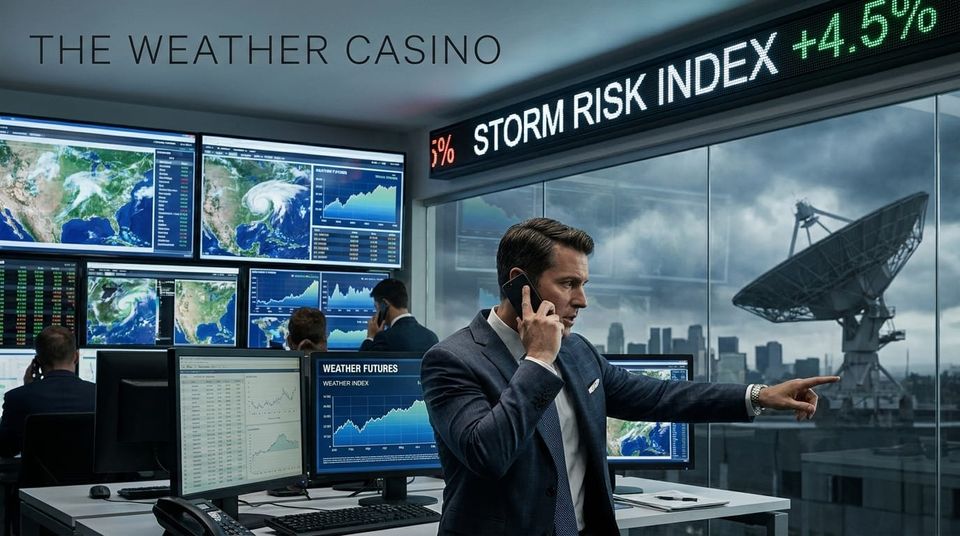
$11.8 billion.
Let that number sink in. It’s not a corporate valuation. It’s not a country’s GDP.
It's the value of a global market built on one thing: the weather.
A market where traders buy and sell contracts based on future temperature, rainfall, and snowfall.
You check the forecast on your phone. It’s free. It’s simple. You decide if you need a jacket.
For some of the world's biggest companies, that same forecast is a high-stakes financial signal. A one-degree error isn't an inconvenience. It's a multi-million dollar event.
Suddenly, 'partly cloudy' has a price tag.
The Price of a Single Degree
Imagine you run a major utility. Your job is to provide power to millions of people.
You have to buy natural gas for the winter. The entire business hinges on one question: how cold will it get?
Buy too much fuel for a mild winter, and you lose millions on unused inventory. Buy too little for a brutal cold snap, and you're forced to buy on the spot market at astronomical prices.
That cost gets passed directly to your customers. To you.
This isn't just about energy. An airline's budget for de-icing fluid is a direct bet on the number of freezing days. A beverage company's sales soar during a heatwave, but plummet during a cool summer.
Nearly one-third of the U.S. economy is sensitive to weather. That’s trillions of dollars of exposure.
So Wall Street did what it always does. It created a way to trade the risk.
Welcome to Weather Futures
These aren't stocks. You can't own a piece of a hurricane. These are derivatives... financial instruments whose value is derived from an underlying asset.
In this case, the 'asset' is a weather index.
Traded on the Chicago Mercantile Exchange (CME), these contracts are built on clean, verifiable data. No emotion. Just numbers.
The system is built on a simple baseline: 65°F (18°C). This is the temperature where most people don't need to turn on their heat or their air conditioning.
Deviations from that baseline are monetized.
- Heating Degree Days (HDD): This is the language of cold. For every degree the average daily temperature is below 65°F, you accumulate HDD points. A frigid day with an average temp of 35°F is worth 30 HDD points. A utility company fearing a cold winter buys HDD futures. If they're right, the contract pays out, offsetting their higher fuel costs.
- Cooling Degree Days (CDD): This is the language of heat. For every degree the average daily temperature is above 65°F, you get CDD points. An amusement park might buy CDD futures. A hot, sunny summer means big crowds, but the payout from their futures contract could hedge against a cool, rainy season that keeps customers away.
- Beyond Temperature: The market is expanding. You can now trade futures on snowfall for cities like Boston, or rainfall in the Midwest corn belt. If it can be measured by the National Weather Service, it can be traded.
The New Weather Forecasters

This market created an arms race for accurate predictions.
The free forecast on your app is good. But it’s not good enough when millions are on the line.
A new industry of private meteorological firms emerged. They don't serve the public. They serve hedge funds and energy traders.
These firms use proprietary models, AI, and massive computing power to find an edge. Their goal is to predict the temperature for Chicago next month more accurately than anyone else.
A forecast that's half a degree better than the competition, delivered three hours earlier, can be the basis for a fortune.
So What Does This Mean For You?
This high-stakes game feels distant. Abstract. But its effects are very real, and mostly positive.
It acts as a massive shock absorber for the economy.
Without it, a single bad hurricane or a record-breaking drought could cause catastrophic price swings. The cost of food, clothing, and energy would be wildly unstable.
This market smooths out the volatility. It allows a farmer to lock in a price for his crop even if a drought hits. It allows your utility company to offer stable, predictable rates.
It’s the hidden financial architecture that turns an 'act of God' into a manageable number on a spreadsheet.
The system is designed so you don't have to experience the full economic fury of a polar vortex.
And as the planet's climate becomes more extreme... more unpredictable... the value of predicting it correctly only goes up.
The next time you check the forecast, remember.
Someone, somewhere, has billions riding on it being right.